Religious Education
Rationale
Our Religious Education (RE) curriculum is designed in line with the agreed syllabus set out by the Standing Advisory Council on Religious Education (SACRE) for Trafford Local Authority. As a compulsory part of the curriculum, RE at Broomwood Primary School covers a broad range of religions and worldviews, enabling children to encounter living faiths, traditions and beliefs.
In adopting this syllabus, we recognise our school community as vibrant, diverse and unique. The local area includes significant communities of Christians, Muslims, Hindus and Sikhs, alongside smaller groups representing other faiths and non-religious worldviews. Through RE, pupils are given opportunities to share their own experiences and to learn from one another, developing understanding and respect for the religions and beliefs represented within both our school and the wider community.
RE also provides meaningful opportunities for children to explore and embed our school’s core values of respect, commitment, nurturing, togetherness and welcoming, which are taught in alignment with British Values. We believe these values support pupils in becoming active, responsible citizens in a diverse and rapidly changing world.
The main purpose of Religious Education, as proposed by SACRE, is as follows:
“The principal aim of RE is to engage pupils in systematic enquiry into significant human questions which religion and worldviews address, so that they can develop the understanding and skills needed to appreciate and appraise varied responses to these questions, as well as develop responses of their own.”
Intent
Our RE curriculum is designed to ensure that children are taught key concepts and ideas from religious and non-religious worldviews in a progressive and coherent way. This enables pupils to build on prior learning, while allowing teachers to plan effectively based on what has been taught previously. By revisiting key concepts, children develop a deep and increasingly complex understanding of RE through the three main strands: believing, expressing and living.
Within these strands, pupils develop substantive knowledge of key concepts and ideas related to religious and non-religious worldviews. These concepts are explored from a range of perspectives, encouraging children to understand how different people may respond to key questions. Our RE curriculum provides opportunities for pupils to articulate their own ideas, engage in reasoning and learn how to agree or disagree respectfully.
Our RE units are structured around key questions taken from the NATRE, enabling children to develop their disciplinary knowledge through a clear progression of discovering (EYFS), exploring (KS1) and connecting (KS2). The RE curriculum is designed to be accessible to all learners. A multisensory approach ensures that pupils of all abilities can access substantive knowledge through practical lessons. These experiences include visitors from different faiths and worldviews, as well as the use of religious artefacts, music and art.
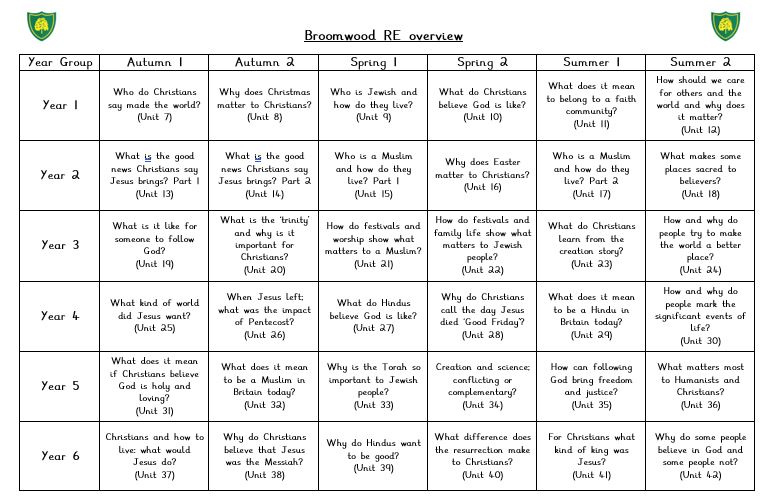
In accordance with SACRE guidance, the long-term plan for RE at Broomwood Primary School can be found below.
Implementation
In accordance with the SACRE for primary schools in Trafford, our RE curriculum meets the legal requirements that RE must be provided for all registered pupils in state-funded schools in England. To ensure the aims and expected standards of the curriculum are delivered effectively, pupils in Year 1 to Year 6 receive one hour of RE teaching per week.
RE at Broomwood Primary School uses a multisensory approach to ensure learning is accessible to all pupils. Children explore the ‘big questions’ within each unit through the use of artefacts, stories, drama and discussion. Where possible, pupils engage with visitors from a range of religious and non-religious worldviews who share their beliefs and practices. This may also include pupils from other classes who belong to a particular faith, providing valuable opportunities to share knowledge and celebrate the diversity within our school community.
Pupils’ learning in RE is evidenced in individual books, where substantive knowledge and understanding are demonstrated through written responses, photographs and QR codes linking to video recordings of spoken responses. Knowledge organisers and vocabulary mats are introduced at the start of each unit and displayed throughout, supporting pupils’ understanding of key concepts, vocabulary, spellings and definitions.
At Broomwood Primary School, children take part in daily collective worship which is rooted in a weekly theme. During assembly, a key quote is introduced as the thought of the week. This theme is then revisited and reflected upon in class during the remaining days, ensuring that collective worship is ongoing and meaningful throughout the week.
Through these themed assemblies and classroom reflections, children explore a range of moral, spiritual and cultural ideas, as well as celebrations and special occasions from around the world. Pupils are encouraged to make connections between the themes explored in collective worship and their learning in RE lessons, supporting deeper understanding and reflection. Across the year, we also recognise and celebrate a variety of religious and cultural festivals through whole-school celebrations.
Impact
At Broomwood Primary School, children develop a secure and progressively deeper understanding of both religious and non-religious worldviews. They build on prior learning and make meaningful links between beliefs, practices and ways of life.
Pupils gain strong knowledge of key concepts across a range of faiths and worldviews. They can express their own ideas clearly, engage in thoughtful discussions and explain similarities and differences between beliefs with respect and sensitivity. Over time, they develop the ability to reason, reflect and respond to important questions, growing both academically and personally.
Through collective worship, visitors, artefacts and practical experiences, pupils develop respect for diversity and a strong sense of belonging within the school and wider community. The RE curriculum supports pupils’ spiritual, moral, social, and cultural development, reinforces Broomwood’s core values and prepares children to become thoughtful, respectful and active citizens in an ever-changing world.