Writing
At Broomwood Primary School we aim to provide an ambitious, inspiring and creative curriculum that gives all children the tools to communicate ideas and emotions fluently and confidently using Standard English through speaking and listening, discussion and writing. Our writing is driven by high quality texts and exposing children to the experience of a variety of authors and text types.
We follow a Mastery approach to writing through the programme ‘Pathways to Write.’ Units of work are delivered using high quality texts and children in all year groups are given varied opportunities for writing. Skills are built up through repetition within the units, and children apply these skills in the writing activities provided. Many opportunities for widening children’s vocabulary are given through the Pathways to Write approach and this builds on the extensive work we do in school to provide our children with a rich and varied vocabulary.
Intent
All aspects of writing are systematically planned to build up schema. During each half-term, two units are taught. One is a unit from Pathways to Write that enables progression through writing opportunities, the application of grammar and punctuation as well as developing vocabulary. The other is from our own bespoke model, which is a genre linked to topics covered within that year group.
To ensure that we cover a wide range of genres as well as target the correct objectives within each year group, we have carefully developed our Whole School Writing Curriculum.
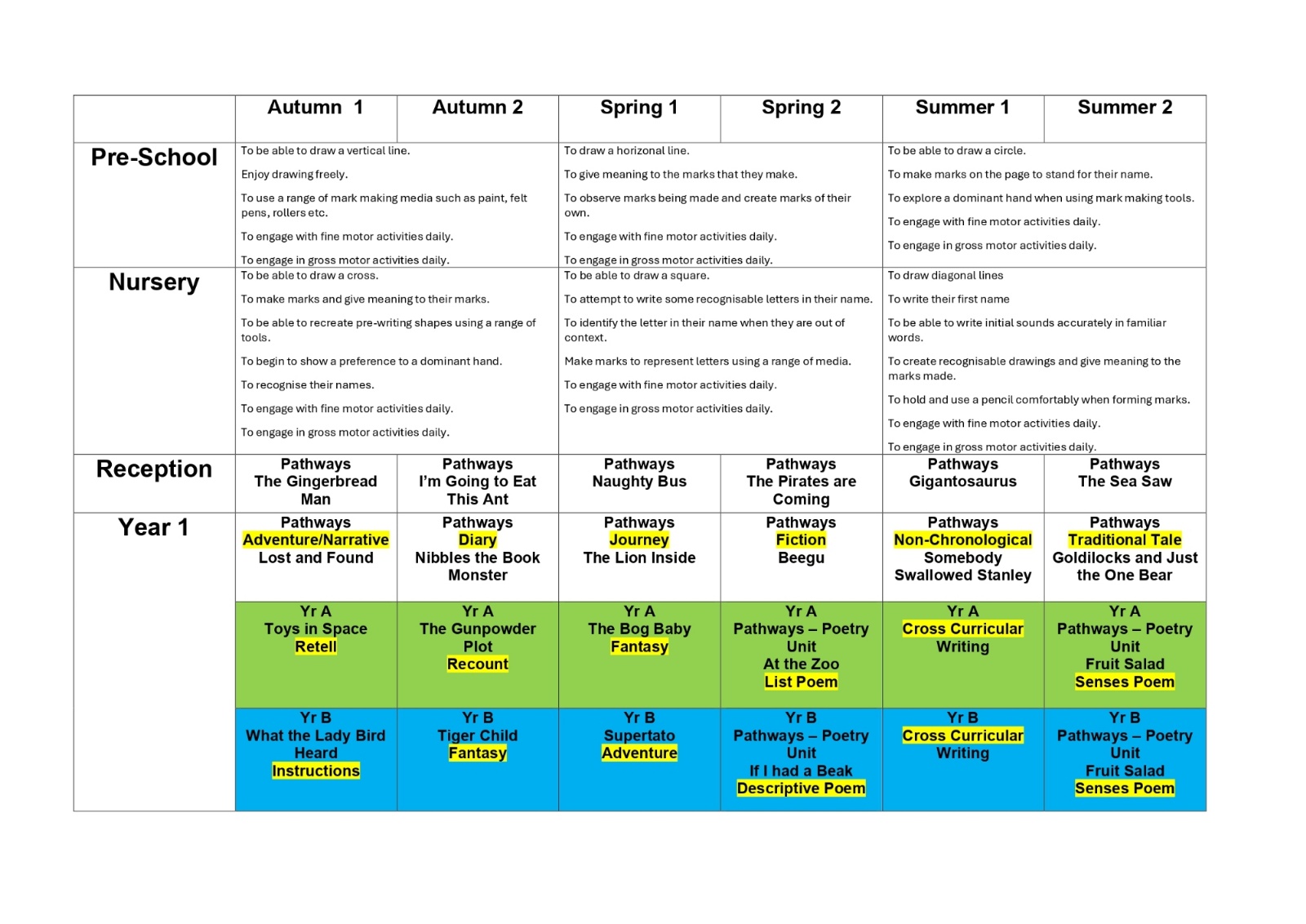
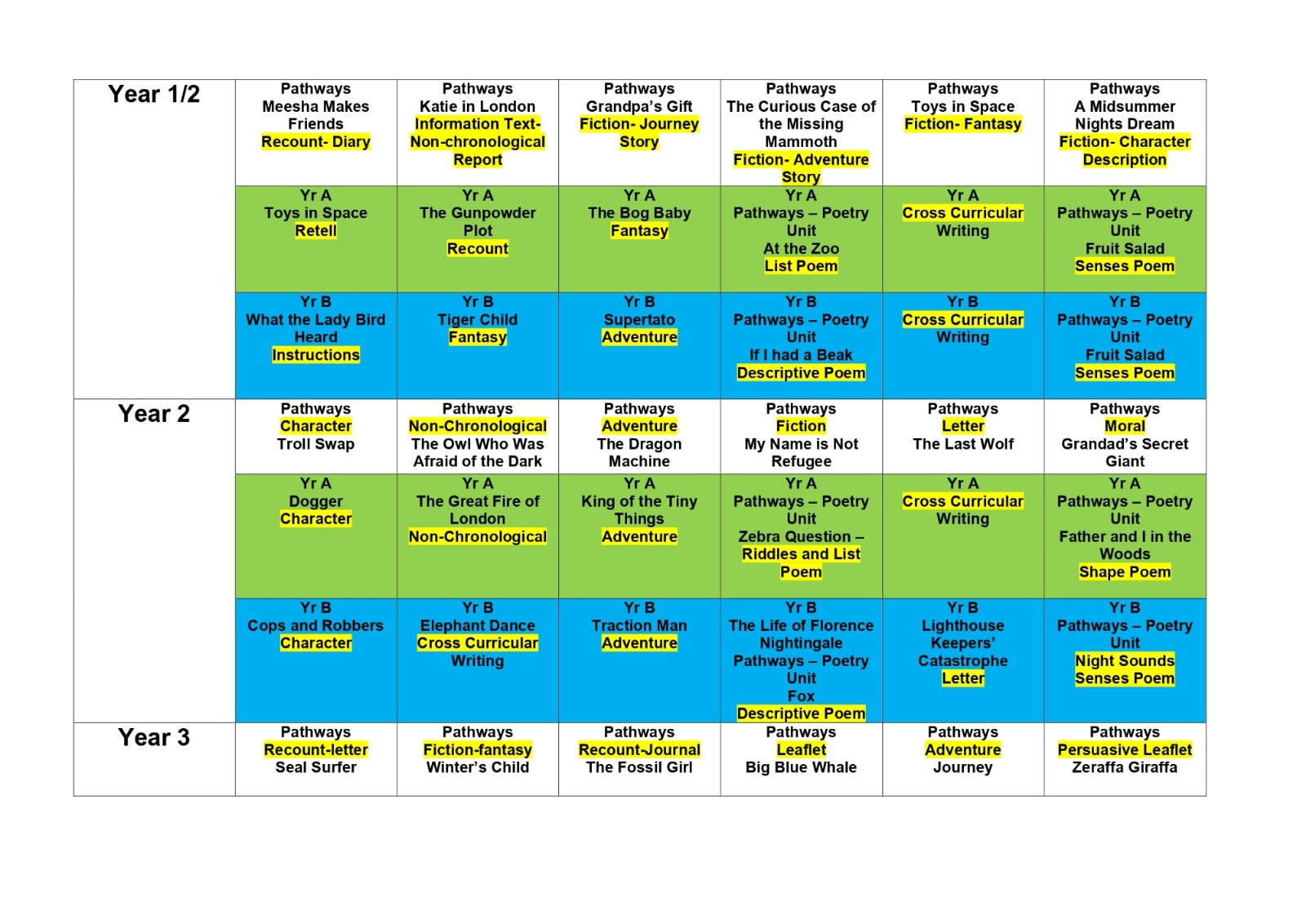
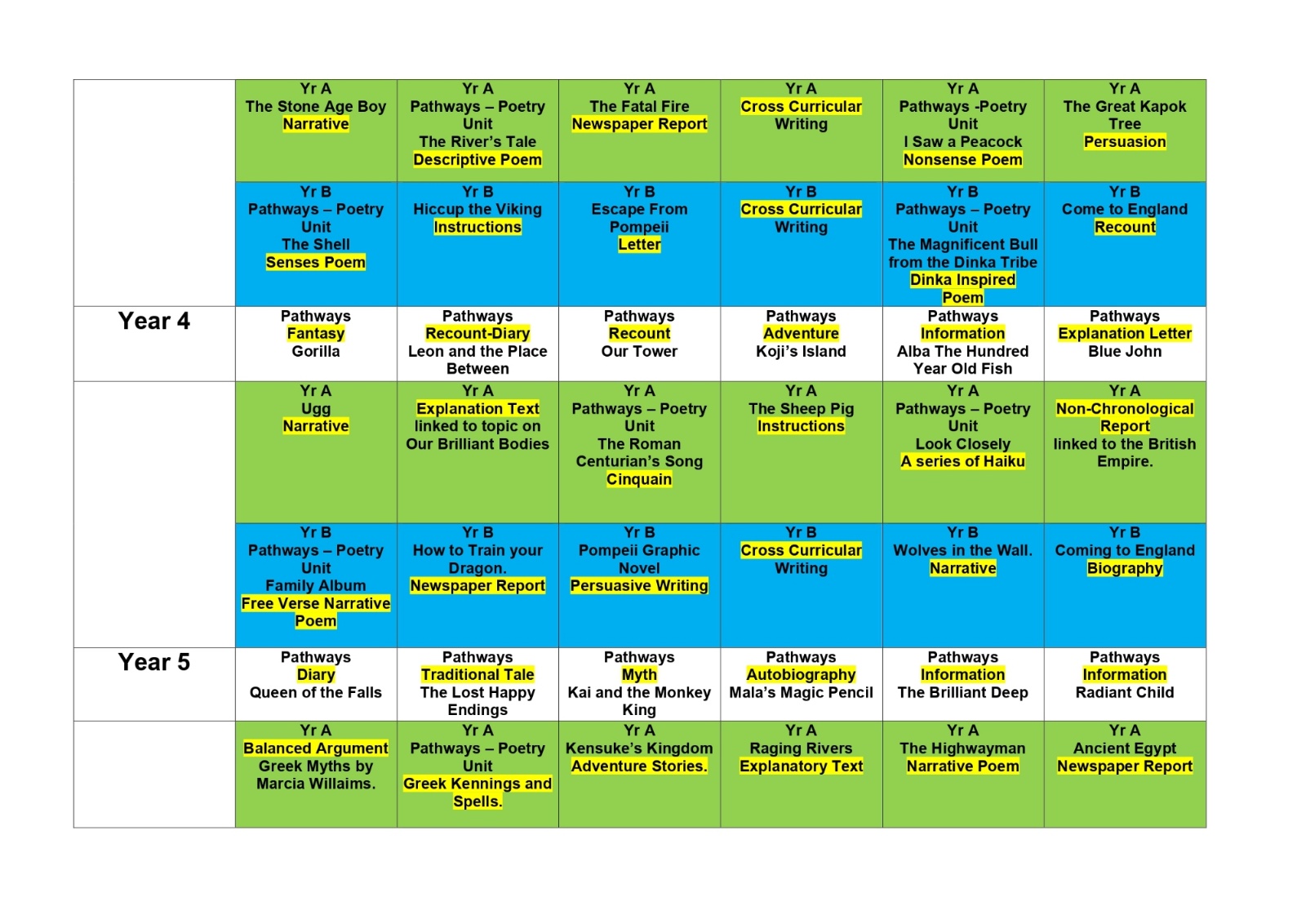
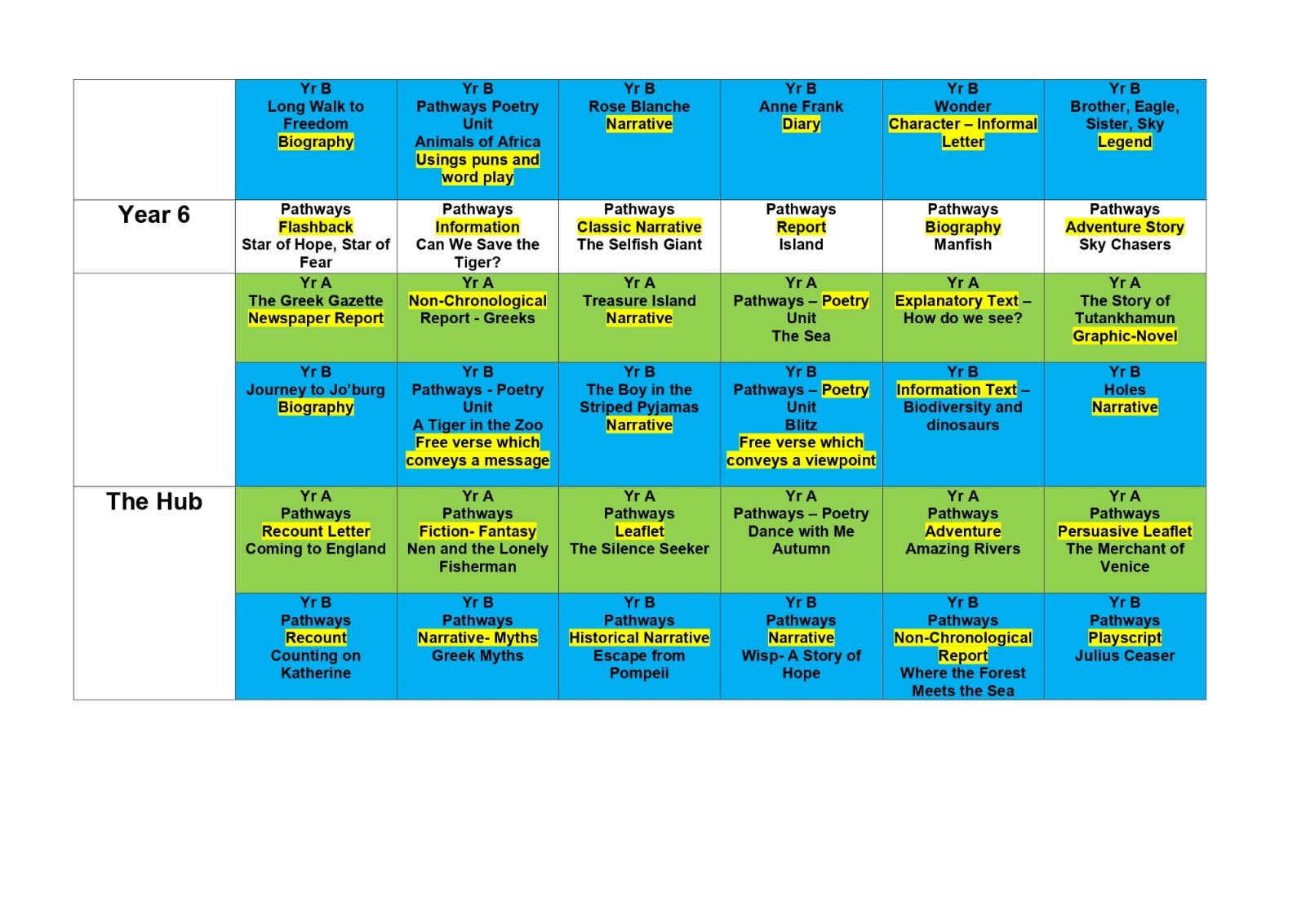
Through the use of Pathways to Write, objectives are built upon across the curriculum with clear progression of skills woven into the curriculum. These objectives are set down in the overview of objectives documents, developed for each year group.
Implementation
We use the writing scheme Pathways To Write to enhance the children’s learning. They provide, units of work which are delivered using high quality texts and children in all year groups are given varied opportunities for writing. Skills are built up through repetition within the units, and children apply these skills in the writing activities provided. Many opportunities for widening children’s vocabulary are given through the Pathways to Write approach and this provides children with a rich and varied vocabulary.
Alongside Pathways to Write, our approach to the teaching of writing is genre based. Children are exposed to a broad and diverse range of genres; fiction and non-fiction; formal and informal. This allows for a complete immersion into a specific style of writing. Learners explore a variety of exemplar texts for the genre that they are studying and identify key linguistic and structural features that define it as well as the purpose of the genre and its key audience.
In EYFS, the focus is on bringing stories to life. Stories are linked carefully to the current topic and children are immersed in the world of the story through exploration, props, images, actions and play. Using reciprocal reading, children practice retelling the story and build their language development through exposure to new vocabulary within and related to the story. Story maps and actions are used to support and build up children’s independence in retelling the story. Children are encouraged to understand the purpose of writing and it becomes a part of their play and used for enjoyment.
Hooks are used at the beginning of every unit to engage, inspire and ‘hook’ the children into the new learning. Providing children with meaningful experiences and essential knowledge ensures that they have the cultural capital and best possible opportunity to access and succeed with their learning. The hooks also tap into children’s creativity and provide a practical context for them to explore a new text and its genre and to provide a purpose for the style of writing. By encouraging children to use stop motion animation to film a scene from a narrative using lego or to become archaeologists and discover historical treasure that will form the basis of a newspaper report, pupils build their cultural capital whilst being immersed in their learning from the very start.
Children are exposed to high-quality examples of punctuation and grammar in the context of their unit and are always provided with the opportunity to apply this learning into their own writing, either through their structured or independent writing, through the editing process or through cross-curricular links in other topics in order to further embed learning. All of the learning of grammar and punctuation is developed through Pathways to Write, ensuring that it has a real-life purpose in the writing that children are producing as well as securing the whole grammar curriculum.
Writing is assessed through Teacher Assessment on a half-termly basis and is based on the short burst writing children create on a daily basis as well as two independent pieces that children complete at the end of each Pathways to Write unit and genre unit. Teachers will use the corresponding assessment documents within the Insight Assessment Programme to make accurate assessments of current writing as well as identifying any gaps in knowledge. In order to ensure that teachers provide an accurate judgement in writing we provide opportunities for in-house moderation and also carry it out with local schools.
Impact
We ensure that all learning is inclusive and accessible, making adjustments where necessary. The structured and assessed pieces of writing as well as continual teacher assessment track the progress of every child ensuring that all children are making progress throughout the school. We use the Pathways to Write Assessment Framework which helps identify gaps and next steps. Where children need to consolidate their learning, a graduated approach of support is implemented for all.
We want all the children to:
- Confidently and coherently communicate ideas and feelings orally and in writing.
- Develop an individual style and flair for writing.
- Understand and enjoy a diverse and high-quality range of fiction and non-fiction texts.
- Understand the purpose and audience of a wide variety of genres.
- Expand their imaginations and creativity and use writing as a tool of exploring new ideas, other worlds, different opinions and new experiences.
- Apply spelling, punctuation and grammar rules to communicate effectively in Standard English.
- Apply their writing skills across all curriculum subjects and in the wider world beyond school, through diaries, written communication (letters, online) and messaging others.
- Have the foundations of language and communication essential for success in later life.
- Be given every opportunity to meet the expected standard or above in writing.
Vocabulary
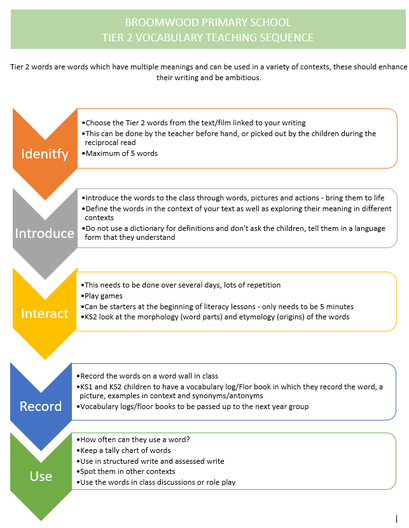
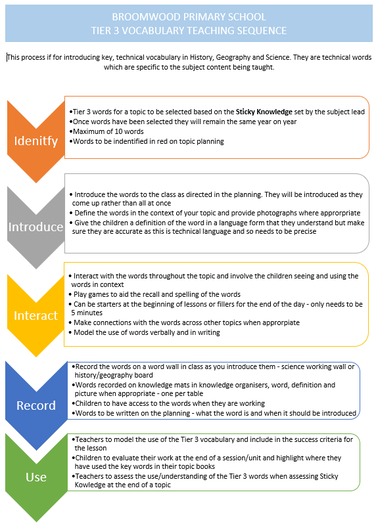
At Broomwood Primary School we follow the tiered approach to vocabulary and build it in to our whole curriculum. Tier 1 is primarily developed during the Early Years, Tier 2 through reading and writing and Tier 3 through topic.
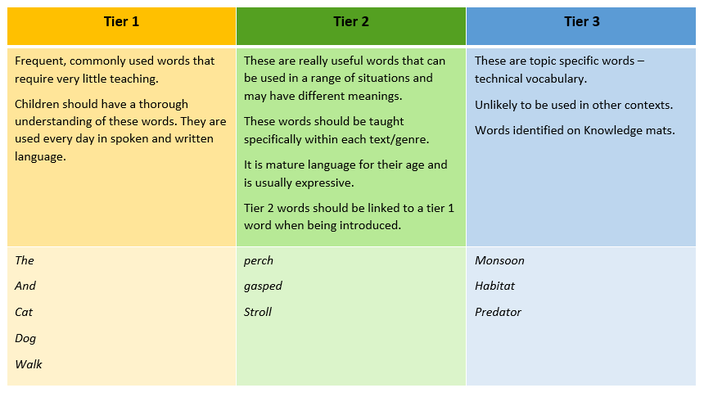
Vocabulary Teaching Sequence